Beyond Zeroes and Ones: Your First Step Into the Quantum Realm
Quantum computing is often described as the future of technology—yet for many, it feels impossibly complex and out of reach. If you’ve ever been curious about what makes it different from classical computing but felt overwhelmed by jargon, you’re in the right place. This article breaks down the fundamentals into clear, simple concepts. You’ll learn what a qubit is, how superposition and entanglement work, and why these ideas matter in the real world. Drawing on deep experience translating advanced tech topics into practical insights, we’ll give you a solid, accessible foundation in quantum computing.
Classical vs. Quantum: A New Computing Paradigm
As we delve into the fundamentals of quantum computing, it’s fascinating to consider how these advancements will complement the Top AI Productivity Tools Transforming Workflows in 2026.
At the heart of every laptop, smartphone, and supercomputer sits the classical bit. A bit is a tiny switch that can be either 0 or 1—nothing in between. This binary system (binary means “two states”) is deterministic, meaning the same input always produces the same output. It’s reliable, predictable, and the reason your calculator doesn’t suddenly decide that 2 + 2 = 5.
But classical systems hit limits. Some problems explode in complexity because of the sheer number of possibilities involved. For example:
- Simulating complex molecules for drug discovery
- Factoring extremely large numbers used in encryption
Even the fastest supercomputers would take thousands—or millions—of years to process certain combinations. (Yes, longer than human civilization has existed.)
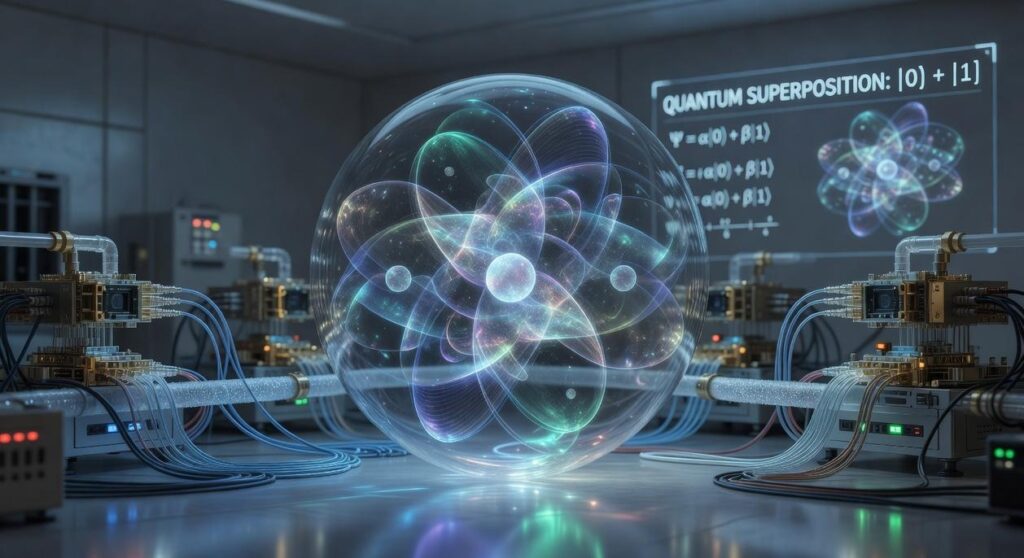
This is where the quantum leap happens. Quantum computing introduction often gets framed as “just faster computing,” but that’s misleading. It’s not a speed boost—it’s a different rulebook. Quantum bits, or qubits, can exist in multiple states at once, a property called superposition. This allows quantum systems to explore many possibilities simultaneously.
So rather than upgrading the engine, we’re changing the physics of the road itself.
The Magic Ingredients: Understanding Qubits and Superposition
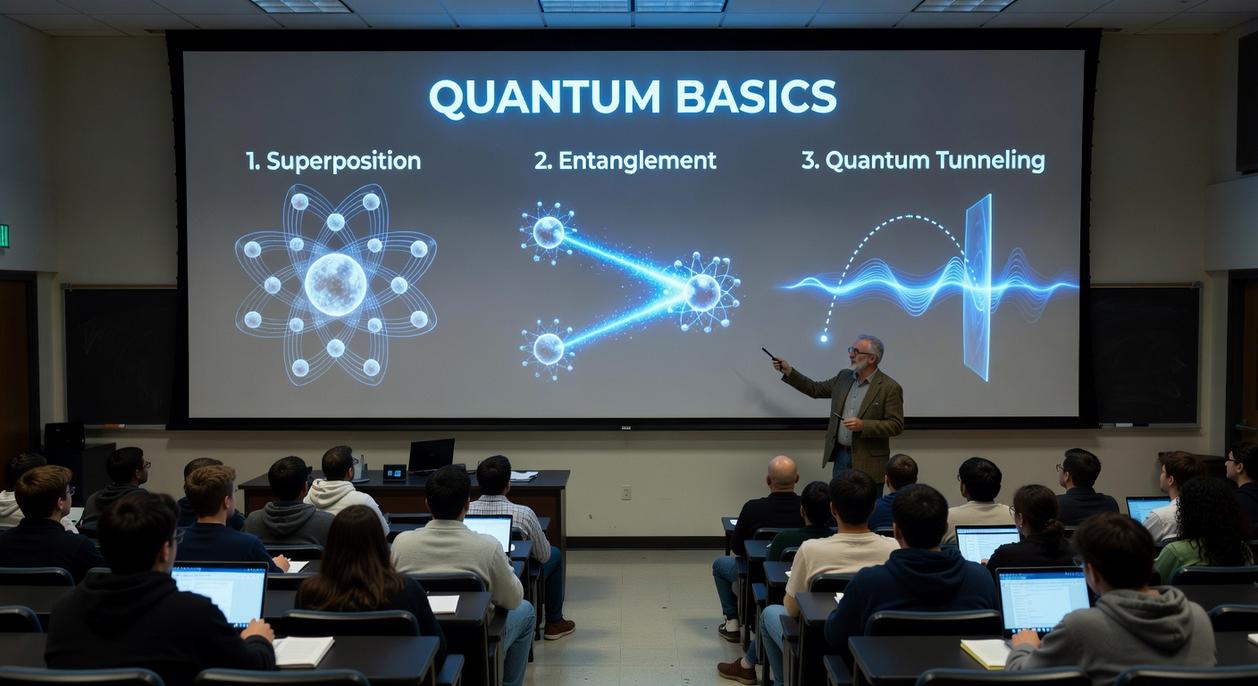
If you’ve ever read a quantum computing introduction, you’ve probably met the star of the show: the qubit. A qubit (short for quantum bit) is the basic unit of information in a quantum computer. Unlike a classical bit—which can only be a 0 or a 1—a qubit can be 0, 1, or a combination of both at the same time. This “combination” state is called superposition.
That sounds abstract, so let’s ground it.
Imagine a classical bit as a coin lying flat on a table. It’s either heads (0) or tails (1). Clear. Definite. Now imagine a qubit as a spinning coin. While it’s spinning, it’s not just heads or tails—it embodies aspects of both simultaneously. Only when you stop the coin (that is, measure it) does it settle into one outcome.
To be fair, physicists still debate the deeper meaning of what’s “really” happening during superposition. Is the qubit physically in two states, or is it our knowledge that’s incomplete? Interpretations vary. But mathematically—and experimentally—the model works (and that’s what engineers care about).
Here’s where the magic scales. Because qubits can exist in multiple states at once, a system with a few hundred qubits can represent an astronomical number of possibilities simultaneously. This is called quantum parallelism—the ability to evaluate many potential outcomes in a single computational step.
Pro tip: This doesn’t mean quantum computers try every answer at once like sci‑fi superbrains. The trick is designing algorithms that amplify the right answer and cancel the wrong ones.
If classical systems rely on structured communication layers like understanding apis the backbone of modern applications, quantum systems rely on precise probability manipulation. Different tools. Radically different rules.
Einstein’s “Spooky Action” refers to entanglement, a phenomenon in quantum physics where two or more qubits—the basic units of quantum information—become profoundly linked. When qubits are entangled, their states, or measurable conditions like spin or polarization, are correlated so tightly that measuring one instantly determines the other, regardless of distance. This isn’t faster-than-light messaging; it’s a shared quantum state described by a single wavefunction.
Picture the classic “linked gloves” analogy. Two gloves go into separate boxes. Open one and find a left-handed glove, and you immediately know the other box holds the right. Entangled qubits behave similarly—except their properties aren’t fixed until measurement, a distinctly quantum twist that baffled Einstein (think less magic, more math).
Why does this matter? ENTANGLEMENT is the ENGINE behind powerful quantum algorithms, enabling parallelism that classical bits can’t replicate. It’s also foundational for quantum error correction, where correlated qubits detect and fix noise, and for quantum key distribution, which flags eavesdropping attempts by disturbing entangled states. In any quantum computing introduction, entanglement stands as a CORE FEATURE because it transforms abstract physics into tangible advantages: SPEED, SECURITY, and computational DEPTH. Without it, quantum systems lose their most distinctive advantage. The promise fades quickly dramatically.
From Theory to Reality: Potential Quantum Applications
We’ve talked about the quantum computing introduction before, but here’s where it gets real. In my view, the most exciting breakthroughs won’t be abstract—they’ll be deeply practical.
First, medicine and materials. Quantum computers could simulate molecules with near-perfect accuracy, a task classical machines struggle with due to combinatorial explosion (when possibilities multiply exponentially). That means faster drug discovery and smarter material design. Imagine designing cancer treatments as precisely as Tony Stark engineers a new suit—minus the cinematic explosions. Critics argue classical supercomputers are “good enough,” but protein-folding limits suggest otherwise (Nature, 2019).
Second, optimization. From:
- Financial market modeling
- Global logistics routing
- Energy grid balancing
Quantum algorithms like QAOA (Quantum Approximate Optimization Algorithm) may outperform classical heuristics in specific cases (Farhi et al., 2014). Some say gains will be marginal. I disagree—small efficiency boosts at global scale mean billions saved.
Finally, AI. Quantum-enhanced machine learning could tackle currently intractable problems, though hardware remains a bottleneck (IBM Quantum reports, 2023). Still, I believe we’re closer than skeptics think.
The Dawn of a New Computational Age
The Dawn of a New Computational Age marks a turning point in how we understand technology and possibility. You now have a clear grasp of the principles that set quantum computing apart—qubits, superposition, and entanglement—and why they matter. This isn’t about marginal speed improvements; it’s about unlocking solutions to problems once thought unsolvable. As breakthroughs in AI, cryptography, and scientific discovery accelerate, your foundation puts you ahead of the curve. Stay curious, keep exploring emerging advancements, and follow the developments shaping this quantum frontier—the future is unfolding, and you’re ready to understand it.
 There is a specific skill involved in explaining something clearly — one that is completely separate from actually knowing the subject. Laurie Moorestevenor has both. They has spent years working with ai tools and machine learning trends in a hands-on capacity, and an equal amount of time figuring out how to translate that experience into writing that people with different backgrounds can actually absorb and use.
Laurie tends to approach complex subjects — AI Tools and Machine Learning Trends, Core Tech Concepts and Innovations, Device Optimization Hacks being good examples — by starting with what the reader already knows, then building outward from there rather than dropping them in the deep end. It sounds like a small thing. In practice it makes a significant difference in whether someone finishes the article or abandons it halfway through. They is also good at knowing when to stop — a surprisingly underrated skill. Some writers bury useful information under so many caveats and qualifications that the point disappears. Laurie knows where the point is and gets there without too many detours.
The practical effect of all this is that people who read Laurie's work tend to come away actually capable of doing something with it. Not just vaguely informed — actually capable. For a writer working in ai tools and machine learning trends, that is probably the best possible outcome, and it's the standard Laurie holds they's own work to.
There is a specific skill involved in explaining something clearly — one that is completely separate from actually knowing the subject. Laurie Moorestevenor has both. They has spent years working with ai tools and machine learning trends in a hands-on capacity, and an equal amount of time figuring out how to translate that experience into writing that people with different backgrounds can actually absorb and use.
Laurie tends to approach complex subjects — AI Tools and Machine Learning Trends, Core Tech Concepts and Innovations, Device Optimization Hacks being good examples — by starting with what the reader already knows, then building outward from there rather than dropping them in the deep end. It sounds like a small thing. In practice it makes a significant difference in whether someone finishes the article or abandons it halfway through. They is also good at knowing when to stop — a surprisingly underrated skill. Some writers bury useful information under so many caveats and qualifications that the point disappears. Laurie knows where the point is and gets there without too many detours.
The practical effect of all this is that people who read Laurie's work tend to come away actually capable of doing something with it. Not just vaguely informed — actually capable. For a writer working in ai tools and machine learning trends, that is probably the best possible outcome, and it's the standard Laurie holds they's own work to.