Technology is evolving at a pace that makes yesterday’s breakthroughs feel outdated almost overnight. If you’re here, you’re likely trying to understand how AI tools, machine learning trends, and emerging tech shifts actually impact security, performance, and real‑world device optimization. The challenge isn’t access to information—it’s separating meaningful innovation from noise.
This article is designed to do exactly that. We break down the most important developments in AI and machine learning, examine how they influence modern systems, and explore critical risks such as network protocol vulnerabilities that can quietly undermine performance and security. You’ll also gain practical insights into optimizing devices and infrastructure in a rapidly changing digital environment.
Our analysis is grounded in continuous monitoring of evolving technologies, hands-on testing of tools, and careful review of current research and security findings—so you can move forward with clarity, not guesswork.
The Invisible Cracks: How Protocol Flaws Endanger Your Digital World
Beneath every login, payment, and video call lie protocols that quietly govern data exchange. When they fail, the fallout is measurable. In 2023, IBM reported the average data breach cost at $4.45 million, often traced to misconfigured or outdated standards. The infamous Heartbleed bug exposed 17% of secure web servers, proving how small code gaps scale.
- Unencrypted legacy traffic invites interception.
- Weak handshake validation enables spoofing.
These network protocol vulnerabilities create silent entry points, disrupting operations and eroding trust. Audit configurations, patch aggressively, and monitor anomalies. Evidence matters.
Mapping the Attack Surface: Where Vulnerabilities Hide in the Protocol Stack
Understanding common network protocol vulnerabilities is crucial for safeguarding your systems, especially if you’re delving into niche areas like gaming on Linux, as discussed in our article ‘Pblinuxgaming‘.
Think of the TCP/IP model as four stacked building blocks: Application, Transport, Internet, and Link. Each layer handles a specific job. The Application layer is what users touch—HTTP, SMTP, DNS. The Transport layer (TCP/UDP) manages sessions and ports. The Internet layer routes packets via IP. The Link layer moves frames across local networks using MAC addresses. Simple in theory. Messy in production (just ask anyone who’s debugged packets at 2 a.m. in a cramped SOC).
Common failure points cluster by function:
- Application: injection attacks, broken authentication, API abuse.
- Transport: session hijacking, SYN floods.
- Internet: IP spoofing, route manipulation.
- Link: ARP poisoning, MAC flooding.
Application attacks dominate breach reports (Verizon DBIR, 2023), largely because web stacks evolve faster than patch cycles. Some argue lower layers are safer because they’re “closer to hardware.” Not quite. Early ARP lacked authentication by design—a protocol flaw, not a coding mistake. That’s different from an implementation bug, like a buffer overflow in a specific TCP stack.
A crack in the foundation weakens every floor above it. If the Link or Internet layer is compromised, upper-layer encryption can’t fully compensate. That’s why network engineers obsess over segmentation and packet inspection when addressing network protocol vulnerabilities.
Case Files: Exploits of TCP, DNS, and BGP in the Wild
Every major cyber incident you read about often traces back to weaknesses in core protocols. These aren’t exotic zero-days—they’re foundational cracks in how the internet communicates.
TCP Vulnerabilities – Denial of Service and Hijacking
A SYN flood attack exploits the TCP three-way handshake (SYN, SYN-ACK, ACK). Normally, a client sends SYN, the server replies with SYN-ACK, and the client completes with ACK. In a SYN flood, attackers send thousands—or millions—of SYN requests but never complete the handshake.
The result? The server allocates memory for half-open connections until resources are exhausted. Legitimate users can’t connect. Services time out. Revenue stalls. (It’s like a restaurant holding tables for guests who never show up.)
Practical tip: Enable SYN cookies on servers and configure connection timeouts aggressively. Most modern firewalls and load balancers include this mitigation.
TCP session hijacking works differently. Here, an attacker predicts or intercepts TCP sequence numbers and injects malicious packets into an active session. If successful, they impersonate a trusted user—potentially accessing sensitive dashboards, emails, or transactions.
Action step: Use encrypted protocols like HTTPS and implement TLS everywhere. Encryption makes injected packets useless without proper cryptographic keys.
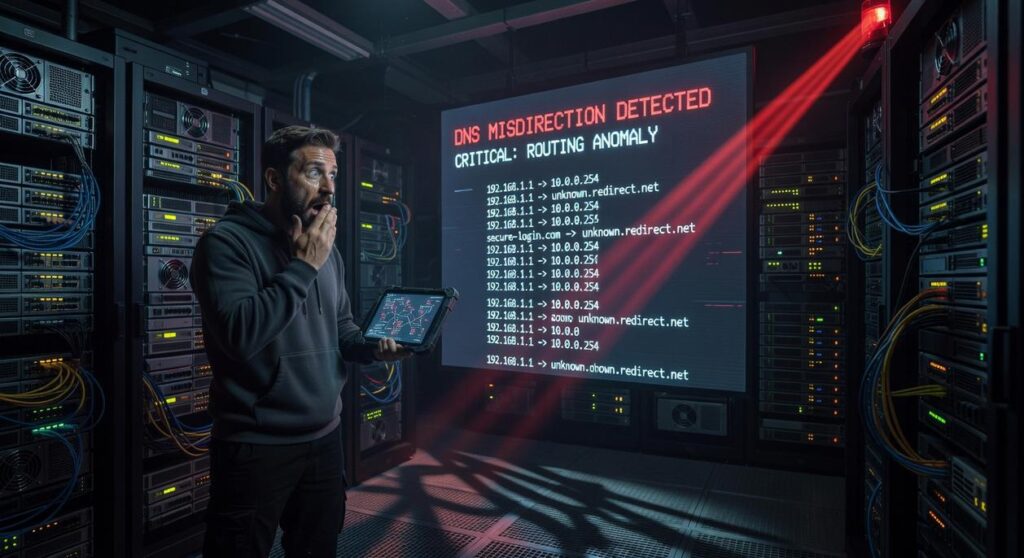
DNS Vulnerabilities – The Misdirection Play

DNS cache poisoning occurs when attackers insert false IP mappings into a DNS resolver’s cache. Instead of pointing “yourbank.com” to its legitimate IP, it resolves to a malicious server.
Users see a familiar login page—but it’s a phishing clone designed to harvest credentials.
Spoofing attacks forge DNS responses to trick resolvers into accepting malicious records. The impact can scale rapidly, especially inside enterprises.
For a deeper enterprise-level breakdown, see how dns exploits can disrupt enterprise systems.
Prevention checklist:
- Enable DNSSEC validation.
- Restrict recursive resolver access.
- Monitor unusual TTL changes.
BGP Vulnerabilities – Rerouting the Internet
BGP hijacking occurs when a malicious or misconfigured network falsely announces ownership of IP prefixes. Because BGP (Border Gateway Protocol) relies heavily on trust, other routers may accept the announcement.
In 2018, a route leak involving a small ISP redirected traffic meant for Amazon Route 53 through an unintended path, briefly disrupting cryptocurrency services. In other cases, hijacks have redirected traffic for surveillance.
Mitigation steps:
- Deploy RPKI (Resource Public Key Infrastructure).
- Filter route announcements strictly.
These incidents highlight how network protocol vulnerabilities can ripple globally—sometimes in minutes.
The Ripple Effect: Quantifying the Business Impact of Protocol Failure
When core systems fail, the damage rarely stays contained. It spreads—financially, operationally, and reputationally—like a row of falling dominoes (and yes, it falls faster than most executives expect).
Direct Financial Costs are the most visible. Downtime alone costs large enterprises thousands to millions per hour, depending on sector (Gartner estimates average IT downtime at $5,600 per minute). Add incident response teams, forensic audits, legal counsel, and regulatory fines under GDPR or CCPA, which can reach up to 4% of annual global turnover. The bill escalates quickly when breaches stem from network protocol vulnerabilities.
Reputational and Customer Trust Damage often hurts more. A DNS hijack that redirects users to phishing pages doesn’t just steal credentials—it shatters confidence. Customers remember. User churn rises. Public companies frequently see short-term stock dips after major breaches (IBM Cost of a Data Breach Report).
Operational Disruption is the silent killer. Protocol failures can freeze internal messaging, halt logistics systems, and paralyze supply chains. Productivity drops far beyond IT. Sales teams lose CRM access. Finance can’t process payments. Suddenly, “just a technical glitch” becomes a company-wide crisis.
Data Integrity and Espionage risks are even more severe. Altered data—subtly changed financial records or tampered analytics—can corrupt decision-making. BGP hijacking has enabled state-level interception of sensitive traffic (U.S. Department of Homeland Security advisories).
Recommendations:
• Implement continuous protocol monitoring and anomaly detection.
• Conduct quarterly incident simulations across departments.
• Encrypt sensitive communications end-to-end.
• Maintain offline, immutable backups.
Pro tip: Treat protocol governance like financial auditing—routine, documented, and board-visible.
Protocol security isn’t abstract—it’s revenue, reputation, and uptime. The real risk? A set-it-and-forget-it mindset toward core infrastructure. When DNS or BGP is misconfigured, attackers exploit network protocol vulnerabilities, causing outages that cost companies $300,000 per hour on average (Gartner). Instead, shift to proactive defense. Implement DNSSEC and RPKI for BGP, enforce disciplined configuration management, and layer continuous monitoring. As a result, you gain resilience, faster incident response, and customer trust. In other words, fewer 3 a.m. fire drills. Start with a strategic audit of protocol settings and patch cycles today. Your business becomes stronger, safer, and future-ready right now decisively.
Stay Ahead of the Risks and Opportunities
You came here to better understand how evolving technologies, AI tools, and emerging threats impact your systems—and now you have a clearer picture of where the real risks and opportunities lie. From smarter device optimization to identifying network protocol vulnerabilities, you’re better equipped to protect performance, security, and long-term scalability.
The reality is that falling behind on protocol weaknesses or machine learning shifts can expose your infrastructure to costly breaches, downtime, and competitive loss. That pain point is real—and it’s growing as systems become more interconnected.
The next step is simple: don’t wait for vulnerabilities to become incidents. Start auditing your protocols, implement proactive monitoring, and leverage trusted, expert-backed insights to stay ahead of emerging threats. Join thousands of tech leaders who rely on our top-rated analysis to spot risks early and optimize with confidence. Explore the latest insights now and strengthen your systems before weaknesses turn into failures.