
Every creator knows the frustration of staring at a blank page, feeling the pressure to produce something fresh, original, and engaging—again. Traditional brainstorming can be slow, repetitive, and often leads to recycled ideas that lack impact. The good news? You don’t have to rely on willpower alone. With generative ai in content creation, AI becomes more than a tool—it becomes a catalyst for sharper thinking and faster ideation. This guide is grounded in hands-on testing of leading AI models and proven prompting workflows. By the end, you’ll have a practical toolkit to generate a near-limitless stream of innovative, high-quality content ideas on demand.
Shifting Your Mindset: AI as a Creative Multiplier, Not a Replacement
As generative AI continues to revolutionize content creation, many creators are also exploring tools like Biszoxtall software to enhance their workflow and efficiency—check out our guide on how to download it for a streamlined experience – for more details, check out our How To Download Biszoxtall Software.
The fear is understandable: if AI can write, design, and brainstorm, what happens to creators? Yet the data tells a different story. A 2023 McKinsey report found that AI augments up to 60–70% of creative and knowledge tasks rather than fully automating them. In practice, creators using generative ai in content creation report faster ideation cycles and higher output quality.
AI works best as a co-pilot, not an autopilot.
Think of it like the navigator in a rally car. The human still drives. The AI reads the terrain, flags patterns, and suggests sharper turns (sometimes ones you wouldn’t have seen coming).
Large Language Models (LLMs)—systems trained on vast datasets to predict and connect language patterns—identify non-obvious relationships across domains. That’s how a marketing concept can borrow structure from behavioral psychology or gaming mechanics. It’s pattern recognition at scale.
| Role | Human Strategist | AI Co-Pilot |
|---|---|---|
| Direction | Sets goals and voice |
Generates tactical options |
| Judgment | Applies context and ethics | Surfaces patterns and drafts |
| Creativity | Chooses bold angles | Expands idea variations |
Skeptics argue automation dulls originality. But case studies from creative agencies show teams using AI-assisted workflows increased campaign iteration speed by over 30% (Deloitte, 2024). The synergy is the advantage: humans define the mission; AI accelerates the execution.
Actionable Prompting Frameworks for Idea Generation
Great ideas rarely appear out of thin air (if only it were that cinematic). They’re usually the result of structured curiosity. Below are four prompting frameworks that consistently unlock sharper, more original thinking—though I’ll admit, results can vary depending on model nuance and how clearly you define context.
The Persona Prompt
A persona prompt instructs AI to adopt a defined professional identity, complete with tone, priorities, and blind spots. For example:
“Act as a CTO of a cybersecurity firm. Propose three product ideas addressing zero-day vulnerabilities for mid-sized fintech companies.”
By specifying role and audience, you shape technical depth and vocabulary. Compare that to:
“Act as a high school teacher explaining ransomware risks to parents.”
Same topic. Entirely different output.
Some argue personas “box in” creativity. That’s fair. But constraints often enhance originality—like how haiku’s strict format sparks poetic ingenuity. Pro tip: add decision-making pressure (“You have a $500k budget and 90 days”) to increase realism.
The “Angle Multiplier” Technique
The Angle Multiplier asks AI to generate multiple perspectives on a single topic. Example:
“For ‘data privacy,’ produce: a contrarian take, a beginner’s guide, an expert deep-dive, and a historical evolution overview.”
This works because it forces contextual reframing. A contrarian angle might argue privacy is becoming performative. A historical lens might trace roots to early cryptography.
I can’t guarantee every angle will feel groundbreaking—but the breadth dramatically improves your odds of finding one worth developing.
Audience Pain Point Mining
Instead of guessing audience struggles, simulate them:
“List the top 10 frustrations small business owners face with social media marketing. For each, generate a solution-focused content idea.”
This mirrors qualitative research. While it’s not a substitute for real interviews (and we should be honest about that limitation), it’s a powerful starting point—especially in generative ai in content creation workflows.
For deeper security-related applications, see the growing role of ai in cybersecurity defense.
The “Concept Blender” Method
The Concept Blender fuses unrelated domains to spark innovation:
“Apply minimalist design principles to personal finance management.”
You might get ideas like subscription decluttering dashboards or visual “budget whitespace.” It’s the creative equivalent of a crossover episode (sometimes brilliant, sometimes awkward).
Not every blend works. But when it does, it produces genuinely novel territory.
Expanding Your Canvas: AI for Visual and Multimedia Content Ideation
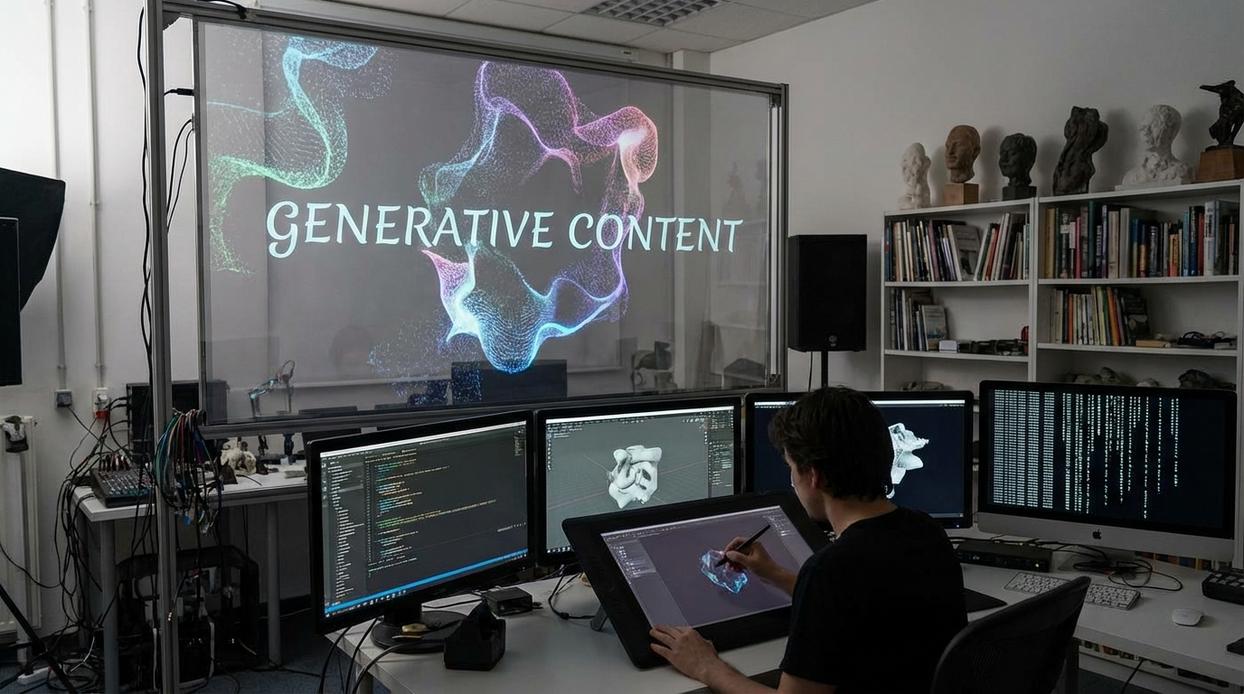
Text-only ideation is powerful—but limiting. Visual-first thinking opens new creative lanes. So instead of blog-only brainstorming, compare Format A: Static Articles vs Format B: Multimedia Concepts. The latter often drives stronger engagement because audiences see and hear your ideas, not just read them (think Netflix trailers vs written summaries).
From Words to Visual Worlds
Video and Podcast Concepts: Rather than asking for “content ideas,” prompt AI for a 5-part video arc, episode hooks, and contrasting guest perspectives. For example, “Debate-style podcast questions on AI ethics” yields sharper angles than generic outlines.
Infographic and Data Visualization: Ask AI to extract 5 key stats, define trends, and suggest layouts (timeline vs comparison grid). Side-by-side visuals clarify complex topics faster than paragraphs.
Social Media Campaigns: Request a unified theme, then platform-specific spins—LinkedIn thought leadership, Twitter threads, Instagram carousels. In generative ai in content creation, specificity beats vagueness every time. Pro tip: Always ask for audience intent alignment.
Navigating the Tools and Avoiding Common Pitfalls
AI tools fall into two broad camps:
- General-purpose LLMs, flexible engines that hum like a busy server room, ready for almost any task.
- Specialized ideation platforms, sharper, more focused systems designed for niche workflows.
Some argue generative ai in content creation makes tools interchangeable. It’s tempting—everything looks sleek, dashboards glowing blue. But inputs matter.
Pitfall 1: Generic Inputs. “Write about tech” produces bland, lukewarm copy. Add constraints, context, texture.
Pitfall 2: Uncritical Acceptance. Output is a draft, not gospel. Review facts, refine tone, layer lived experience until it feels distinctly yours.
Pro tip:
Your Blueprint for Infinite Content Inspiration
You came here looking for a scalable way to generate fresh ideas on demand—and now you have a repeatable system to do exactly that. The constant pressure to produce new, engaging content isn’t going away. Deadlines stack up. Audiences expect more. Creativity alone isn’t enough.
That’s why combining human strategy with machine-scale pattern recognition works so well. generative ai in content creation amplifies your thinking, spots patterns you might miss, and helps you turn one idea into dozens without losing quality or intent.
Now take action: choose one technique—like the Concept Blender—and use it in your very next content planning session. Test it. Stretch it. Build momentum from it.